
Salaries -> Salaries -> New salary
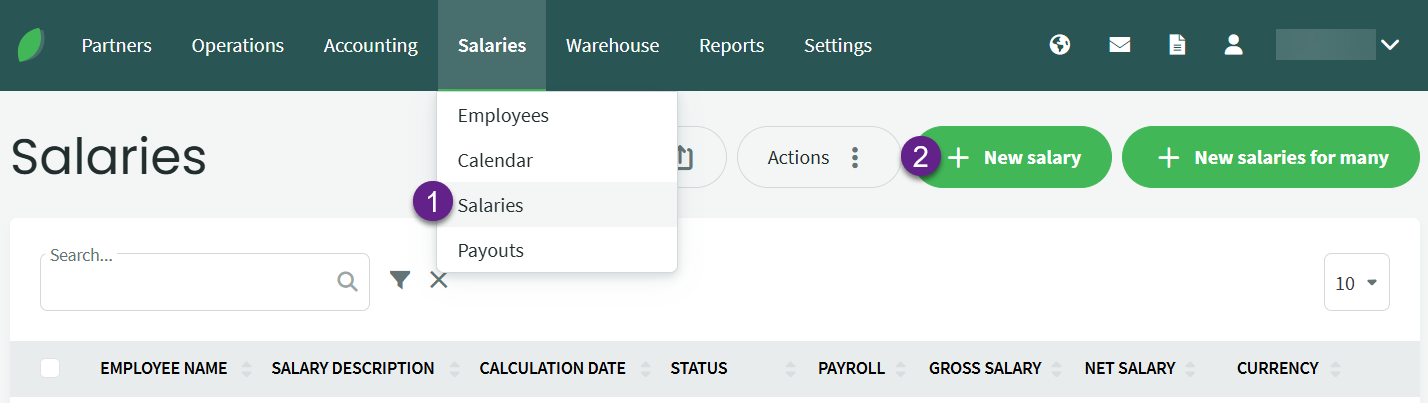
There are two options for adding salaries: for one employee at a time or for multiple employees at once.
To add a salary for one employee, click the “New Salary” button. To calculate salaries for multiple employees at once, select “New salaries for many”.
Make sure that the salary and the applicable taxes have been set up on the employee card beforehand..
The calculation method is generally the same for all salary types. Tax obligations may vary depending on the salary type, and they must be correctly defined on the employee card.
In this guide, we will cover adding a new salary for one employee at a time. The salary entry view consists of five panels:
- General information
- Salary parts
- Withholdings
- Taxes
- Holidays information and aggregated payroll
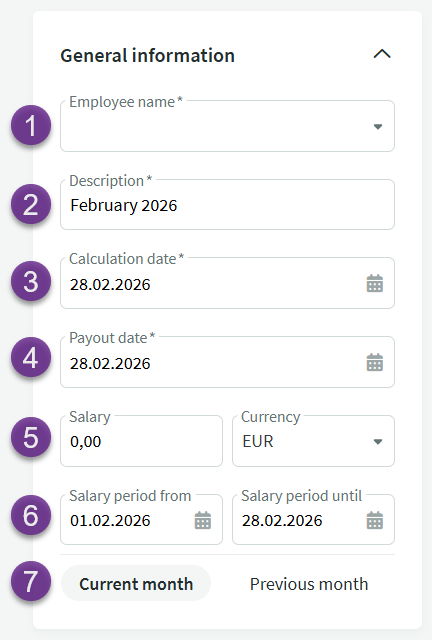
- First, select the employee’s name.
- In the Description field, enter the name of the month for which the salary is being calculated.
- The system generates an expense entry based on the Calculation date. If the salary is calculated for the entire month, the calculation date is usually the last day of the month.
- Payout date is the payday agreed upon in the company, as defined in the settings.
- This field is filled in automatically by the system based on the salary lines.
- Set the start and end date of the salary period. When the period is changed, the salary data is loaded from the employee card and calendar events , such as vacation, sick leave, etc., are also taken into account.
- The period shortcuts are “Current month” and “Previous month“. When a shortcut is used, the following fields are updated automatically: description (2), calculation date (3), payout date (4) and salary period (6).
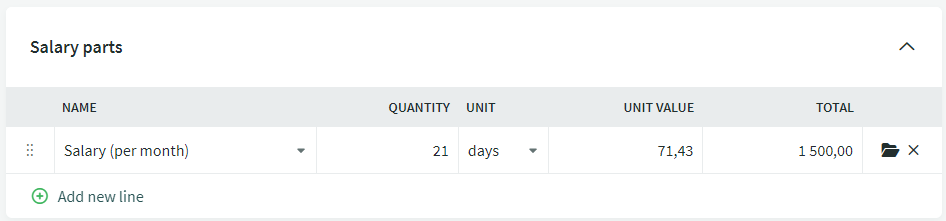
Once the general information has been entered, you can modify or add salary parts if needed, for example add a bonus.
To add a new salary part, click “Add new line” and select the appropriate salary type from the drop-down menu.
Tip If vacation days have not been entered in the calendar and you add a vacation pay row directly in the salary view, the vacation pay amount will not be calculated automatically. It will also not be reflected correctly in the vacation days report. Therefore, all absences in the calculation period should be entered in the calendar before preparing the salary calculation.In the Salary parts panel, the salary amount is displayed according to the data set on the employee card, such as monthly salary or hourly wage.
If hourly wage calculation has been selected on the employee card, the salary calculation displays the monthly standard working hours by default, provided that no absences have been entered in the calendar. If the employee works part-time or according to a schedule, the number of hours worked must be adjusted if needed. Separate work schedules cannot be created in SimplBooks.
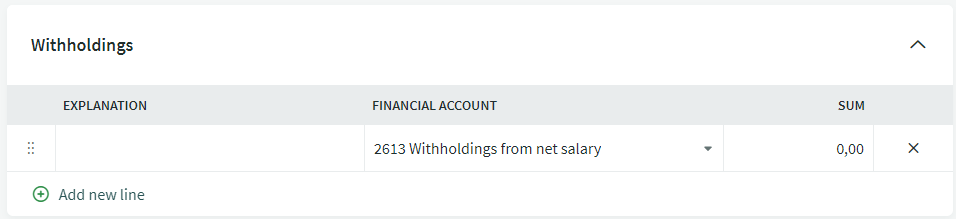
This section shows withholdings from the employee’s net salary, for example bailiff claims.
By default, the financial account is set to 2613 Withholdings from net salary. When such an obligation is fulfilled, it must be marked as paid with a financial transaction.
The default withholdings account can be changed in “Settings -> Automatic transactions -> Salaries -> Withholdings from salary.”
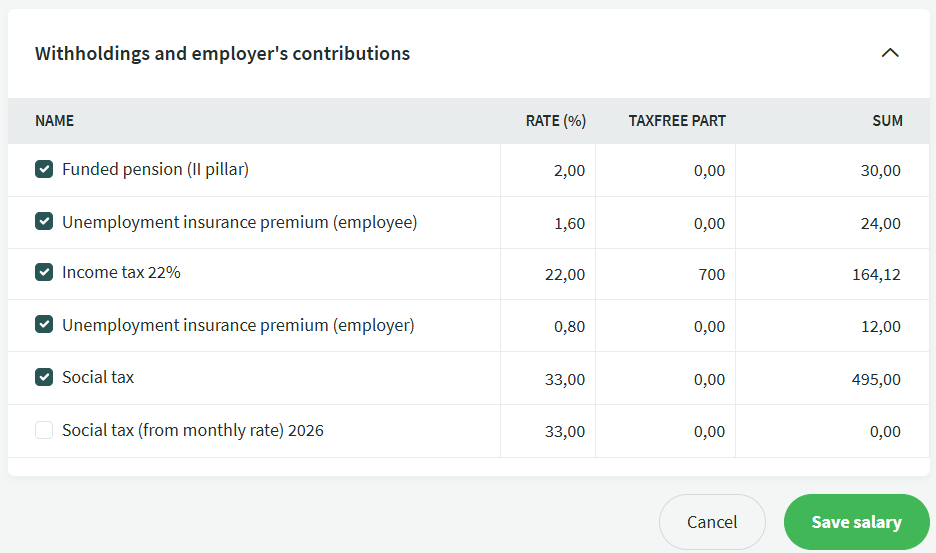
Taxes applicable to the salary can be selected or adjusted in the “Withholdings and employer’s contributions” panel by ticking the checkbox in front of the tax name.
If tax-free amount is applied when calculating income tax on the employee’s salary, it must be entered in the “Tax-free part” field on the income tax line.
Tip To avoid errors, we recommend setting the applicable taxes and the tax-free amount on the employee card.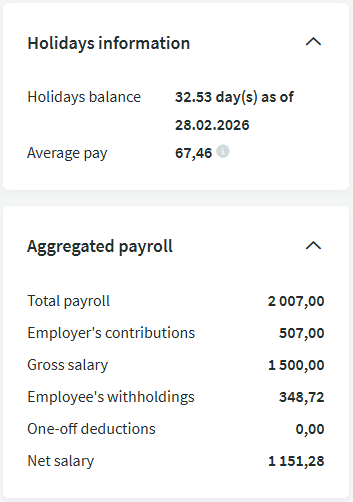
The Holidays information panel displays the number of vacation days accumulated by the end date of the calculation period and the 6-month average calendar day rate.
The info button next to the average calendar day rate shows the data used for the calculation.
The 6-month average calendar day rate is not displayed if no salary has been entered for the employee during the 6 months preceding the selected period.
The aggregated payroll table shows the employer’s total cost, total tax amounts and the net and gross salary.
Once all information has been checked, save the salary.
For any additional questions, please write to us at support@simplbooks.ee.

Leave A Comment?